 Image 1 of 4
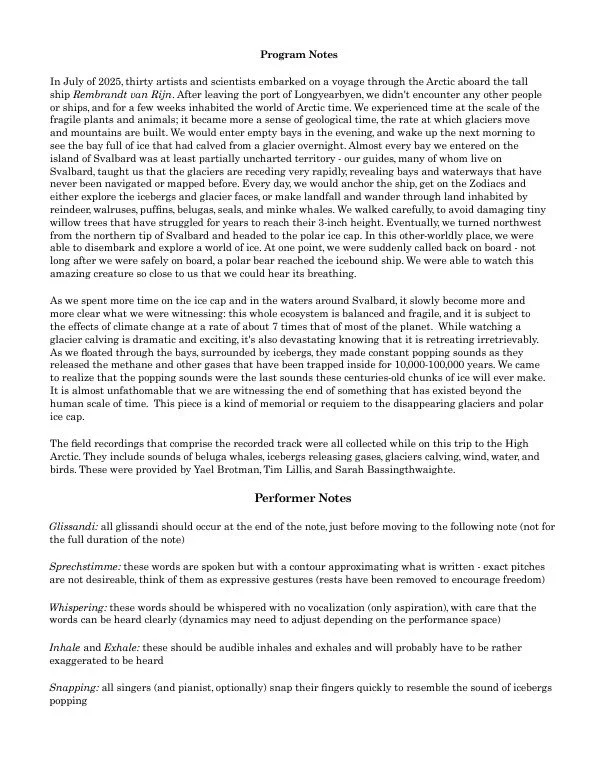 Image 2 of 4
 Image 3 of 4
 Image 4 of 4
Narrator, Piccolo, Trumpet, Strings
(2026)
9 minutes
In July of 2025, thirty artists and scientists embarked on a voyage through the Arctic aboard the tall ship Rembrandt van Rijn. After leaving the port of Longyearbyen, we didn't encounter any other people or ships, and for a few weeks inhabited the world of Arctic time.
We experienced time at the scale of the fragile plants and animals; it became more a sense of geological time, the rate at which glaciers move and mountains are built. We would enter empty bays in the evening, and wake up the next morning to see the bay full of ice that had calved from a glacier overnight. Almost every bay we entered on the island of Svalbard was at least partially uncharted territory - our guides, many of whom live on Svalbard, taught us that the glaciers are receding very rapidly, revealing bays and waterways that have never been navigated or mapped before. Every day, we would anchor the ship, get on the Zodiacs and either explore the icebergs and glacier faces, or make landfall and wander through land inhabited by reindeer, walruses, puffins, belugas, seals, and minke whales. We walked carefully, to avoid damaging tiny willow trees that have struggled for years to reach their 3-inch height.
Eventually, we turned northwest from the northern tip of Svalbard and headed to the polar ice cap. In this other-worldly place, we were able to disembark and explore a world of ice. At one point, we were suddenly called back on board - not long after we were safely on board, a polar bear reached the icebound ship. We were able to watch this amazing creature so close to us that we could hear its breathing. Finally, finding no food, it eventually moved on. Knowing how difficult finding food is on the shrinking ice cap, it was possible that this bear might go hungry for a long time. As we spent more time on the ice cap and in the waters around Svalbard, it slowly become more and more clear what we were witnessing: this whole ecosystem is balanced and fragile, and it is subject to the effects of climate change at a rate of about 7 times that of most of the planet. While watching a glacier calving is dramatic and exciting, it's also devastating knowing that it is retreating irretrievably. As we floated through the bays, surrounded by icebergs, they made constant popping sounds as they released the methane and other gases that have been trapped inside for 10,000-100,000 years. We came to realize that the popping sounds were the last sounds these centuries-old chunks of ice will ever make. It is almost unfathomable that we are witnessing the end of something that has existed beyond the human scale of time. The recorded sounds were all collected while on this trip.
They include sounds of beluga whales, icebergs releasing gases, glaciers calving, wind, water, and birds. These were provided by Yael Brotman, Tim Lillis, and Sarah Bassingthwaighte.
Narrator, Piccolo, Trumpet, Strings
(2026)
9 minutes
In July of 2025, thirty artists and scientists embarked on a voyage through the Arctic aboard the tall ship Rembrandt van Rijn. After leaving the port of Longyearbyen, we didn't encounter any other people or ships, and for a few weeks inhabited the world of Arctic time.
We experienced time at the scale of the fragile plants and animals; it became more a sense of geological time, the rate at which glaciers move and mountains are built. We would enter empty bays in the evening, and wake up the next morning to see the bay full of ice that had calved from a glacier overnight. Almost every bay we entered on the island of Svalbard was at least partially uncharted territory - our guides, many of whom live on Svalbard, taught us that the glaciers are receding very rapidly, revealing bays and waterways that have never been navigated or mapped before. Every day, we would anchor the ship, get on the Zodiacs and either explore the icebergs and glacier faces, or make landfall and wander through land inhabited by reindeer, walruses, puffins, belugas, seals, and minke whales. We walked carefully, to avoid damaging tiny willow trees that have struggled for years to reach their 3-inch height.
Eventually, we turned northwest from the northern tip of Svalbard and headed to the polar ice cap. In this other-worldly place, we were able to disembark and explore a world of ice. At one point, we were suddenly called back on board - not long after we were safely on board, a polar bear reached the icebound ship. We were able to watch this amazing creature so close to us that we could hear its breathing. Finally, finding no food, it eventually moved on. Knowing how difficult finding food is on the shrinking ice cap, it was possible that this bear might go hungry for a long time. As we spent more time on the ice cap and in the waters around Svalbard, it slowly become more and more clear what we were witnessing: this whole ecosystem is balanced and fragile, and it is subject to the effects of climate change at a rate of about 7 times that of most of the planet. While watching a glacier calving is dramatic and exciting, it's also devastating knowing that it is retreating irretrievably. As we floated through the bays, surrounded by icebergs, they made constant popping sounds as they released the methane and other gases that have been trapped inside for 10,000-100,000 years. We came to realize that the popping sounds were the last sounds these centuries-old chunks of ice will ever make. It is almost unfathomable that we are witnessing the end of something that has existed beyond the human scale of time. The recorded sounds were all collected while on this trip.
They include sounds of beluga whales, icebergs releasing gases, glaciers calving, wind, water, and birds. These were provided by Yael Brotman, Tim Lillis, and Sarah Bassingthwaighte.