 Image 1 of 3
 Image 2 of 3
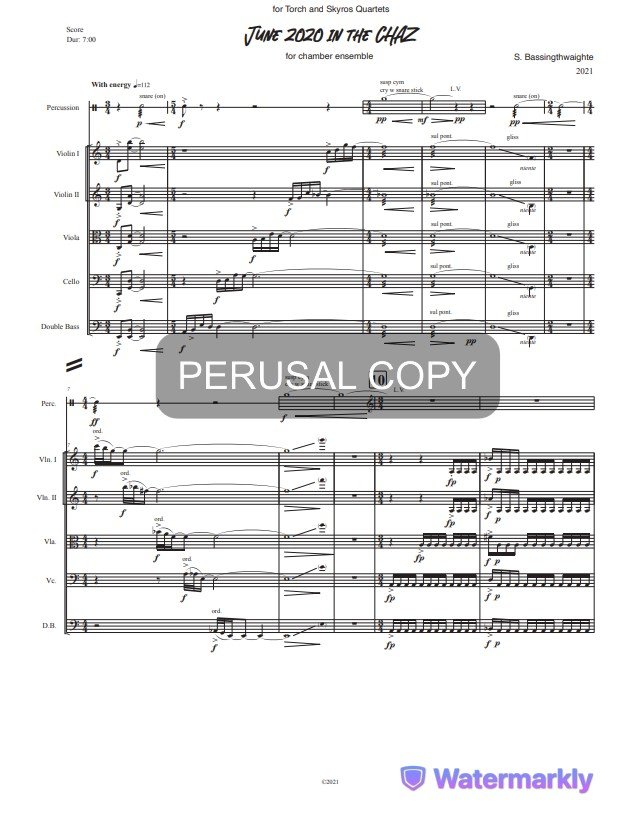 Image 3 of 3
Program Note
CHAZ is the Capitol Hill Autonomous Zone in Seattle, which came into being in May and June of 2020. Its creation evolved from the Black Lives Matter protests following the death of George Floyd. It’s location in and near Cal Anderson park is close to my own home, and I do my grocery shopping, go to the gym, and walk my dog right here. Having a tiny friendly poodle is a good way to strike up conversations, so Tessa and I would walk through the CHAZ and talk to people about why they’re here, what are their experiences, what are their hopes, what do they need. Tessa, my son, and I also participated in several Black Lives Matter marches.
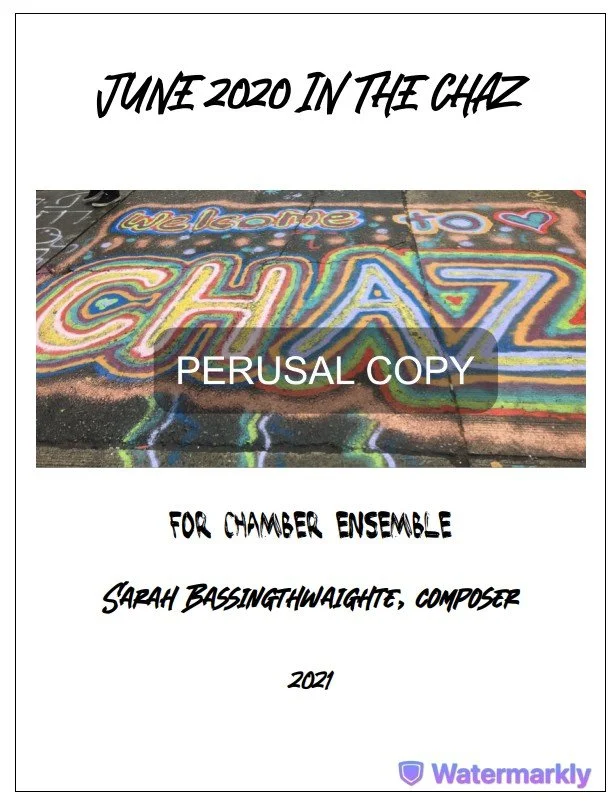
The focus of the Common Tones Music Festival this year is “Resistance and Dance.” I thought for awhile about what experience I had most related to both of these activities, and realized that CHAZ was the perfect inspiration for my piece. CHAZ was, above all, a happy and inspired place – people were excited, filled with positive energy, with hope for change and for justice, and supported by community. They had speakers come every day to educate and inspire the crowd, poets recited, musicians played, documentaries and educational films were played in the evenings, and when no organized events were happening, people danced. People helped each other, offered free food, free clothing, free cell phone charging. They planted a large community garden, which is the only thing in the park left to commemorate this resistance movement. In my own personal experience, it was a very vibrant, positive, community-oriented movement to resist systemic racism and to seek equality and justice. After a couple of months, the protest became more organized, and the area changed its name to the Capitol Hill Organized Protest(CHOP). This signaled a different era of the movement and this piece is not about the CHOP. The photos on the front and back covers are ones I took on my phone as I walked through the CHAZ, and my memories there always make me smile.
There are a few musical threads that run through this piece. The snare at the opening is a call to action, and the strings enter one-by-one, following each other in ascending 4-note groups, like the beginnings of a protest march. The energy has a couple of false starts at the beginning, with the strings doing a slow glissando downward. The bowed cymbal creates a feeling of discomfort and tension, and the strings again feed off of each other’s energy, sometimes following in an organized way, other times almost seeming to trip over each other. The woodblocks join the strings, contributing a dancy, fun timbre. Throughout the piece, there is a back-and-forth between the tension, anger, and determination of the resistance movement, and the joyful energy of community and of positive partnership.
As the strings continue their energetic conversation, at a mini-climax, the clarinet joins in with a fresh voice. The clarinet and strings work together, like the marchers and speakers of the CHAZ. Just as the energy starts to wind down, (perhaps in the wee hours of the morning), at an upward-winding anti-climax, the trumpet finally makes its appearance, with a Perfect 4th motive that reappears many times in the piece – this motive is reminiscent of a bugle call, a call to action. The section that follows is more contemplative and introspective, and many smaller conversations happen here, a sort of evolution or development of ideas. This gradually builds again for a third time, and the climax of this section ends in the Perfect 4th motive presented bi-tonally by the trumpet and clarinet together. This bold statement is responded to with dance and joyous self-expression, with consecutive vibraphone, then clarinet, then trumpet solos. Finally, everyone comes together in a bright, dancy, fun, yet determined final shout.