 Image 1 of 4
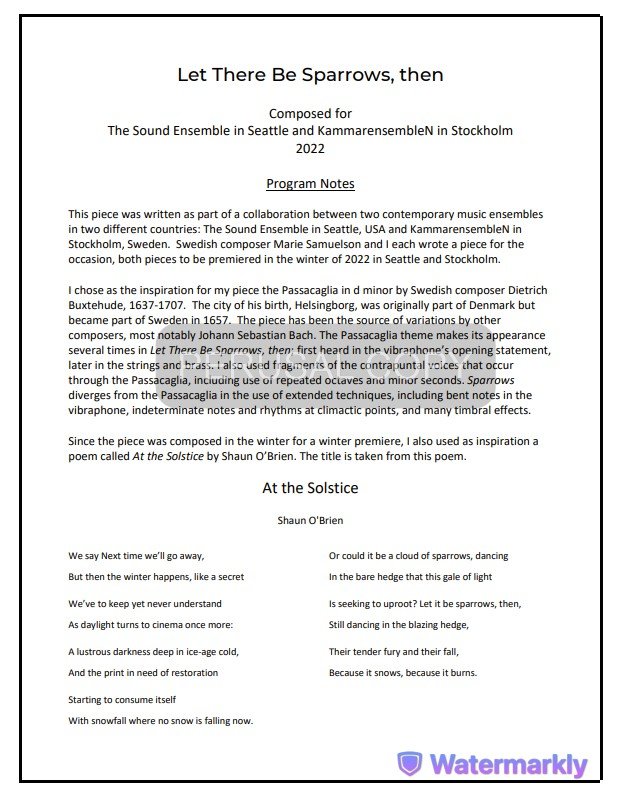 Image 2 of 4
 Image 3 of 4
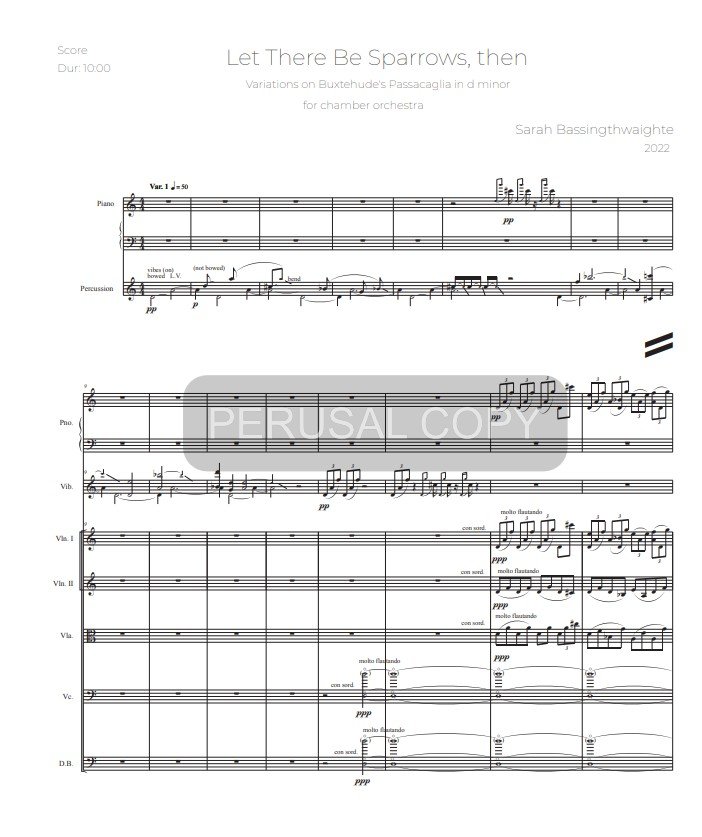 Image 4 of 4
Chamber Orchestra 1111 | 1110 | pno | 1 perc | strings
(2022)
11 minutes
This piece was written as part of a collaboration between two contemporary music ensembles in two different countries: The Sound Ensemble in Seattle, USA and KammarensembleN in Stockholm, Sweden. Swedish composer Marie Samuelson and I each wrote a piece for the occasion, both pieces to be premiered in the winter of 2022 in Seattle and Stockholm. I chose as the inspiration for my piece the Passacaglia in d minor by Swedish composer Dietrich Buxtehude, 1637-1707. The city of his birth, Helsingborg, was originally part of Denmark but became part of Sweden in 1657. The piece has been the source of variations by other composers, most notably Johann Sebastian Bach. The Passacaglia theme makes its appearance several times in Let There Be Sparrows, then; first heard in the vibraphone’s opening statement, later in the strings and brass. I also used fragments of the contrapuntal voices that occur through the Passacaglia, including use of repeated octaves and minor seconds. Sparrows diverges from the Passacaglia in the use of extended techniques, including bent notes in the vibraphone, indeterminate notes and rhythms at climactic points, and many timbral effects. Since the piece was composed in the winter for a winter premiere, I also used as inspiration a poem called At the Solstice by Shaun O’Brien. The title is taken from this poem.
Chamber Orchestra 1111 | 1110 | pno | 1 perc | strings
(2022)
11 minutes
This piece was written as part of a collaboration between two contemporary music ensembles in two different countries: The Sound Ensemble in Seattle, USA and KammarensembleN in Stockholm, Sweden. Swedish composer Marie Samuelson and I each wrote a piece for the occasion, both pieces to be premiered in the winter of 2022 in Seattle and Stockholm. I chose as the inspiration for my piece the Passacaglia in d minor by Swedish composer Dietrich Buxtehude, 1637-1707. The city of his birth, Helsingborg, was originally part of Denmark but became part of Sweden in 1657. The piece has been the source of variations by other composers, most notably Johann Sebastian Bach. The Passacaglia theme makes its appearance several times in Let There Be Sparrows, then; first heard in the vibraphone’s opening statement, later in the strings and brass. I also used fragments of the contrapuntal voices that occur through the Passacaglia, including use of repeated octaves and minor seconds. Sparrows diverges from the Passacaglia in the use of extended techniques, including bent notes in the vibraphone, indeterminate notes and rhythms at climactic points, and many timbral effects. Since the piece was composed in the winter for a winter premiere, I also used as inspiration a poem called At the Solstice by Shaun O’Brien. The title is taken from this poem.