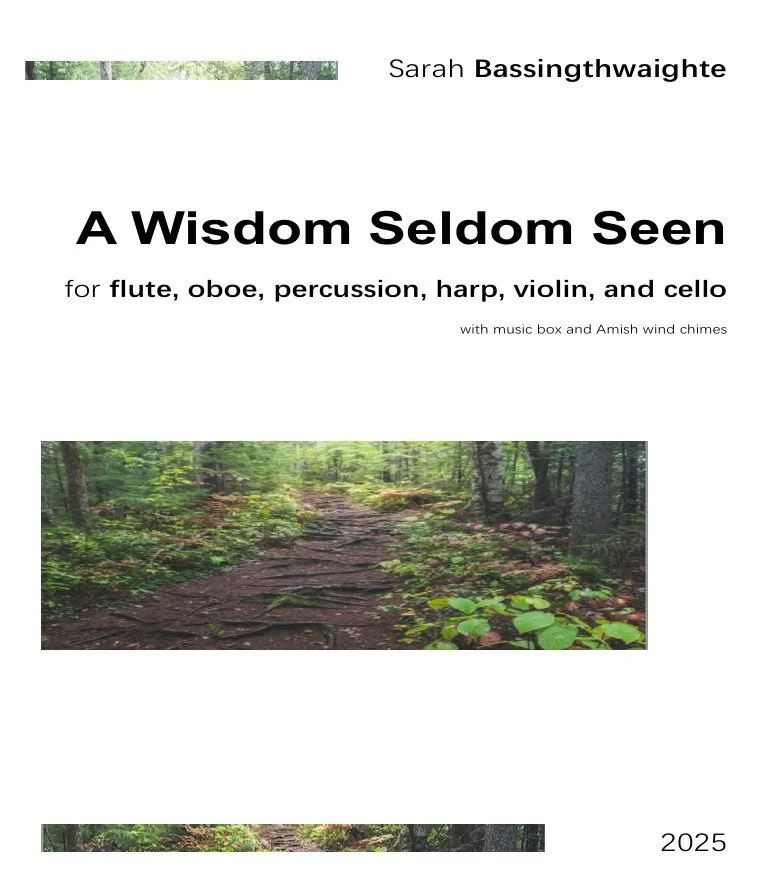
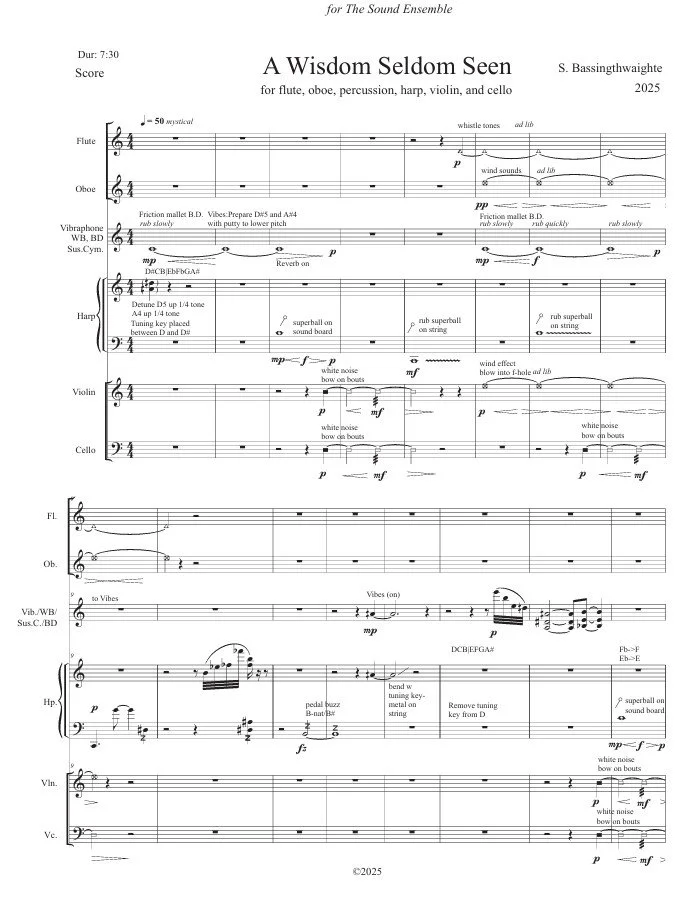
Flute, Oboe, Percussion (Vibraphone), Harp, Violin, Cello (with music box & chimes)
(2025)
8 minutes
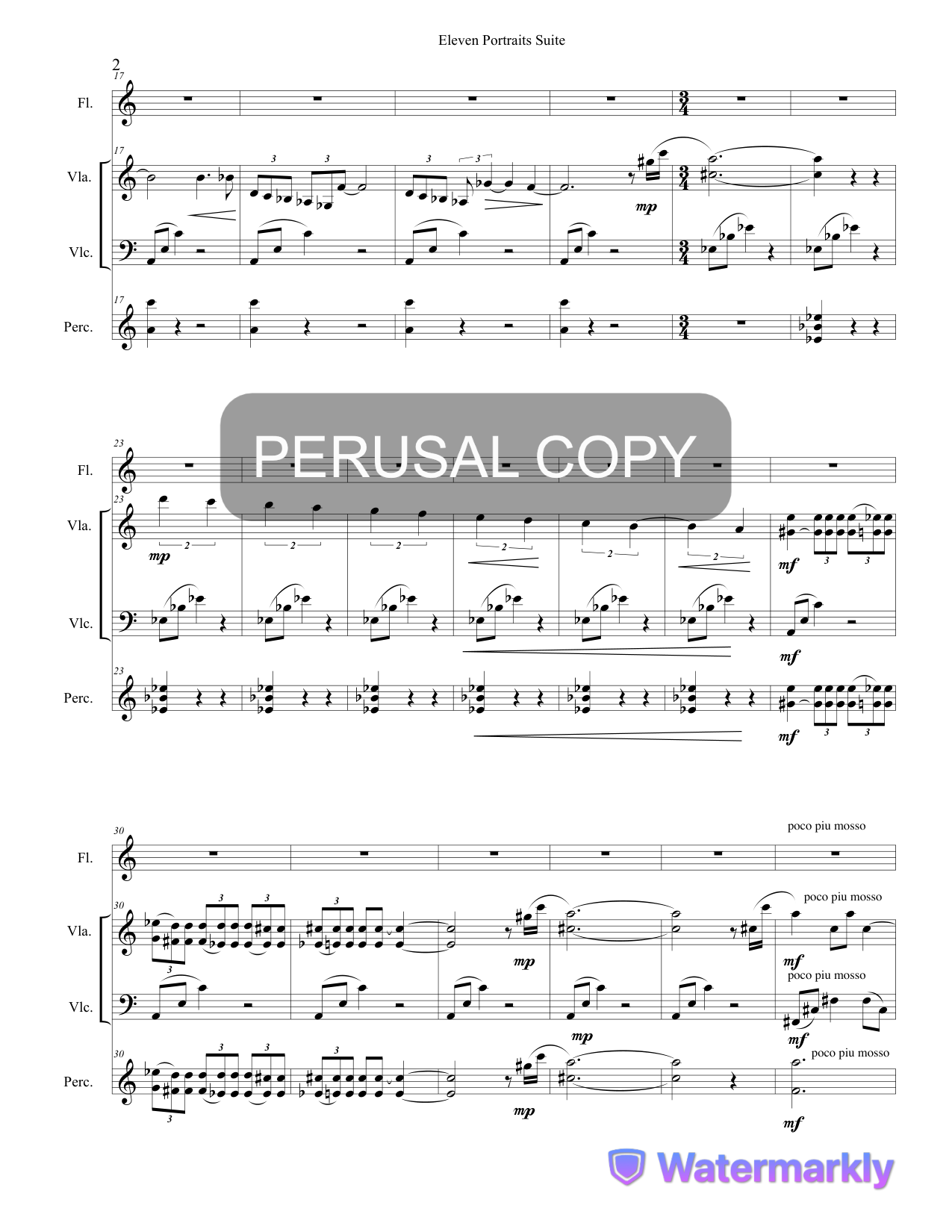
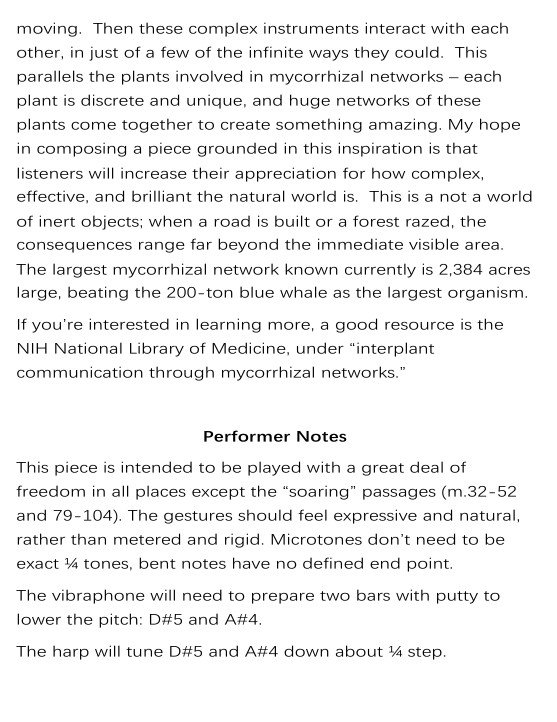
A Wisdom Seldom Seen is a chamber piece inspired by the unique and intelligent forms of communication undertaken in the plant world. The hyphae of mycorrhizal fungi create an underground network connecting all kinds of plants, including trees, to each other. This network is used to convey nutrients between plants and communicate information, including imminent dangers such as disease, fires, or logging. The responses to the information are adaptive and happen very quickly; for example, trees can enact defense mechanisms against a disease or fire before it reaches the tree. The fungi share soil nutrients with the trees, and in turn, the trees share carbohydrates resulting from photosynthesis. The NIH describes all of this as intelligent "behavior," furthering the knowledge that plants behave with intentionality and cooperation, in a complex, intelligent, effective system.
In this piece, I hope to evoke a mystical, energetic, somewhat alien atmosphere, as humans might feel while observing the plant world. Each of the instruments creates unusual sounds; microtones, sounds of friction and wind, bent tones, intricately weaving lines, subdued yet exquisite colors. Each of the instruments has its own beauty – colors, textures, ways of moving. Then these complex instruments interact with each other, in just of a few of the infinite ways they could. This parallels the plants involved in mycorrhizal networks – each plant is discrete and unique, and huge networks of these plants come together to create something amazing. My hope in composing a piece grounded in this inspiration is that listeners will increase their appreciation for how complex, effective, and brilliant the natural world is. This is a not a world of inert objects; when a road is built or a forest razed, the consequences range far beyond the immediate visible area. The largest mycorrhizal network known currently is 2,384 acres large, beating the 200-ton blue whale as the largest organism. If you're interested in learning more, a good resource is the NIH National Library of Medicine, under "interplant communication through mycorrhizal networks."
Performer note (optional, technical): This piece is intended to be played with a great deal of freedom in all places except the "soaring" passages (m.32-52 and 79-104)…
Wind Ensemble
(2025)
7 Minutes
▶️ 6’30” Watch Video
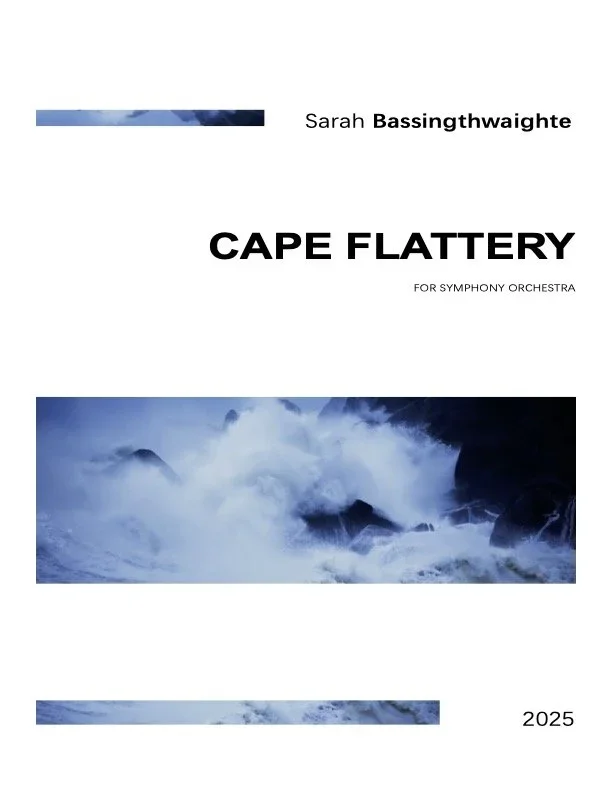
Grand Prix Winner of the 2025 European Classical Music Awards 2025, Winner of the 2024 International Saint-Saëns Competition in Orchestral Composition and the 2025 Georges Bizet International Competition
Finalist for the 2025 American Prize in Orchestral Composition
Also available as Orchestral: Picc, 2 fl, ob, eh, 2 cl, bass cl, alto sax, tenor sax, bari sax, 3 tp, 4 horn, 2 tb, 1 bass tb, euph, tuba, piano, timpani, 3 perc.
Finalist for the American Prize in Wind Ensemble Composition 2026
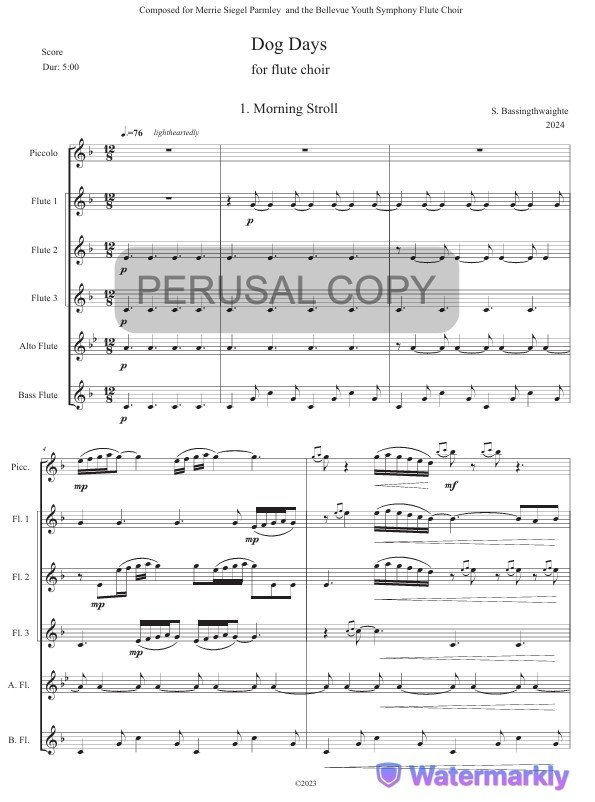
Piccolo, 4 C-Flutes, Alto Flute, Bass Flute
(2024)
5 minutes
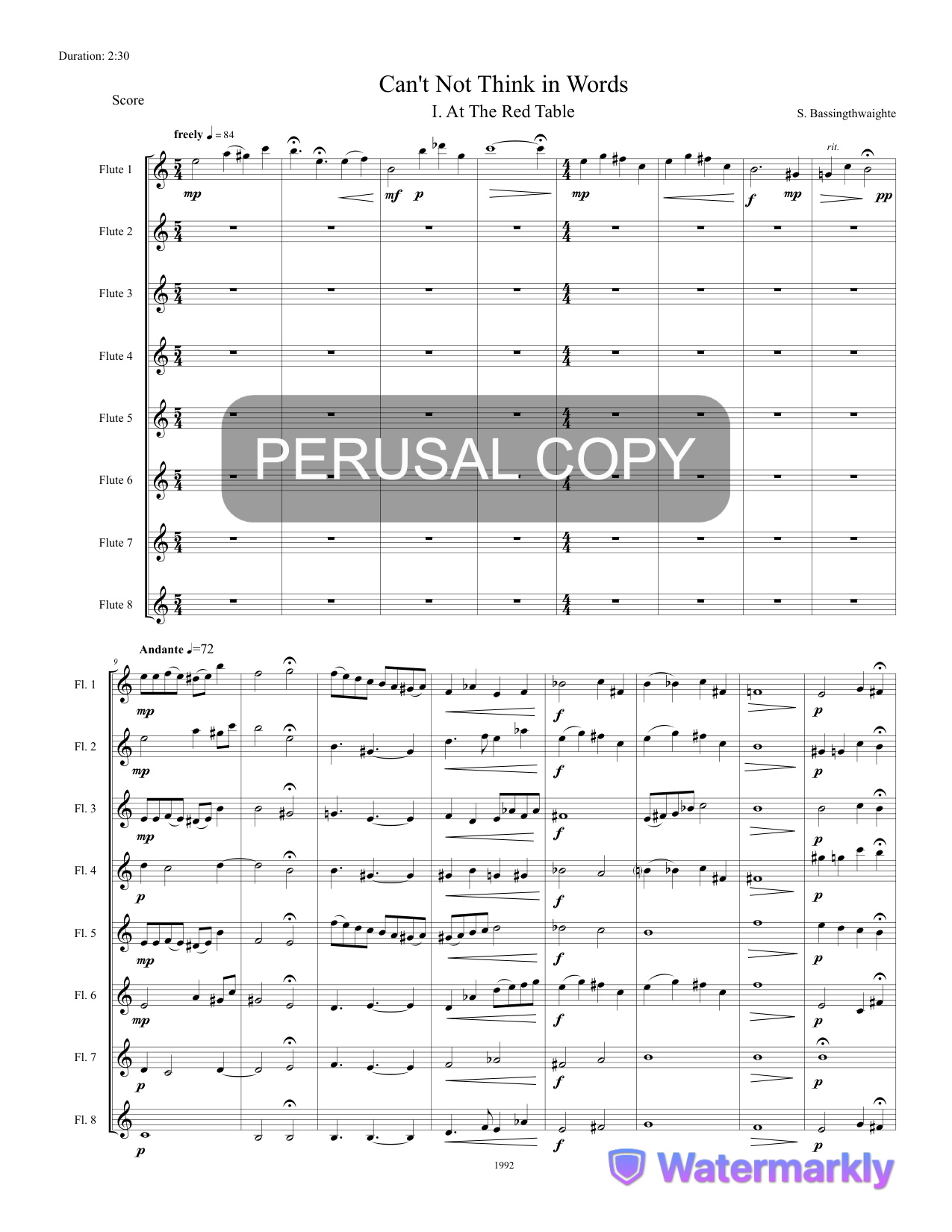
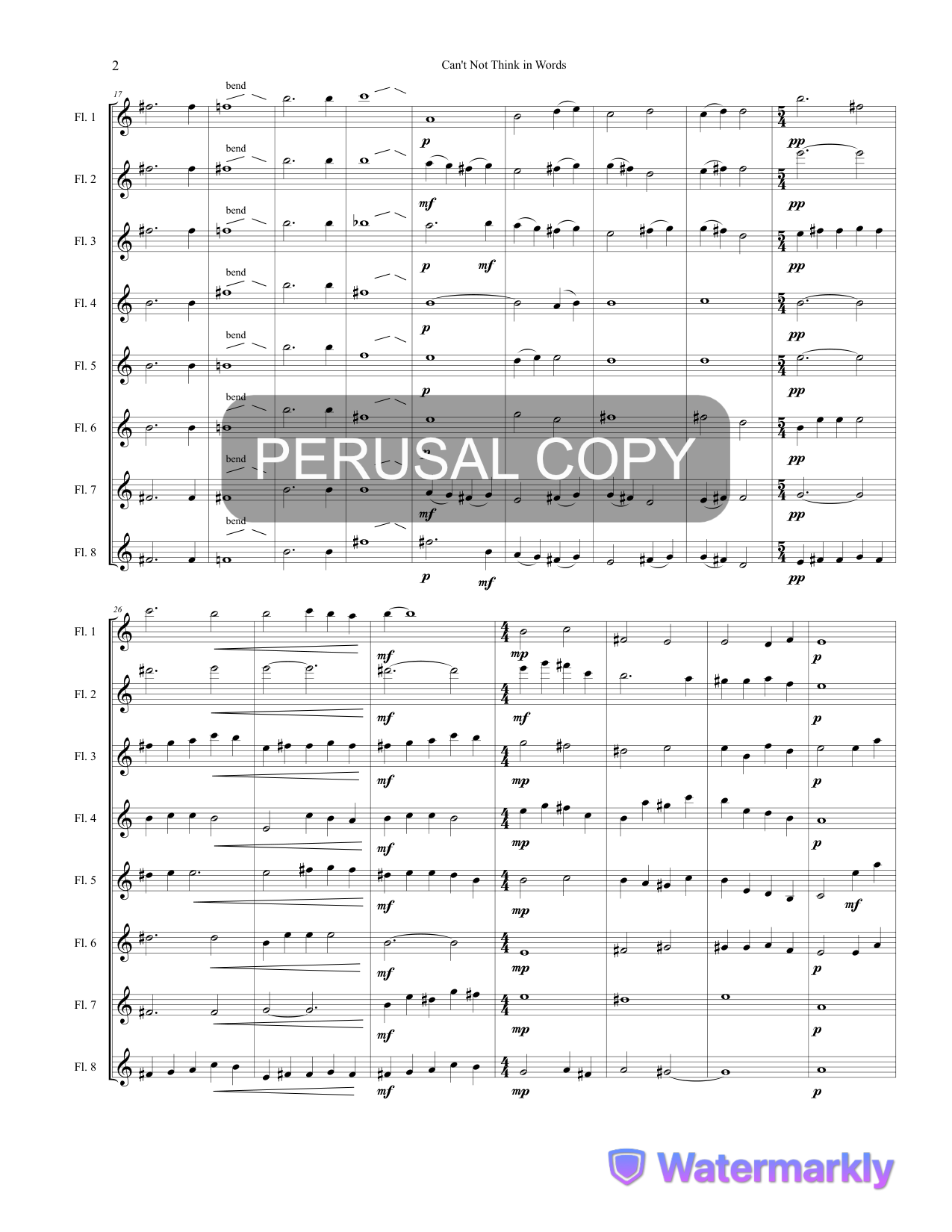
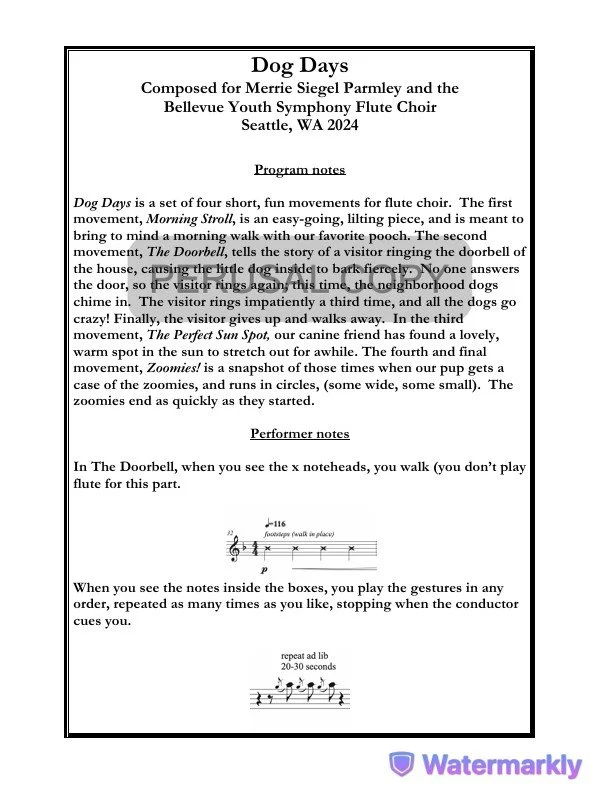
Dog Days is a set of four short, fun movements for flute choir. It was composed for Merrie Siegel Parmley and the Bellevue Youth Symphony Orchestra Flute Choir. In four movements: Morning Stroll, The Doorbell, The Perfect Sun Spot, and Zoomies!
Four C-Flutes
(2024)
6 minutes
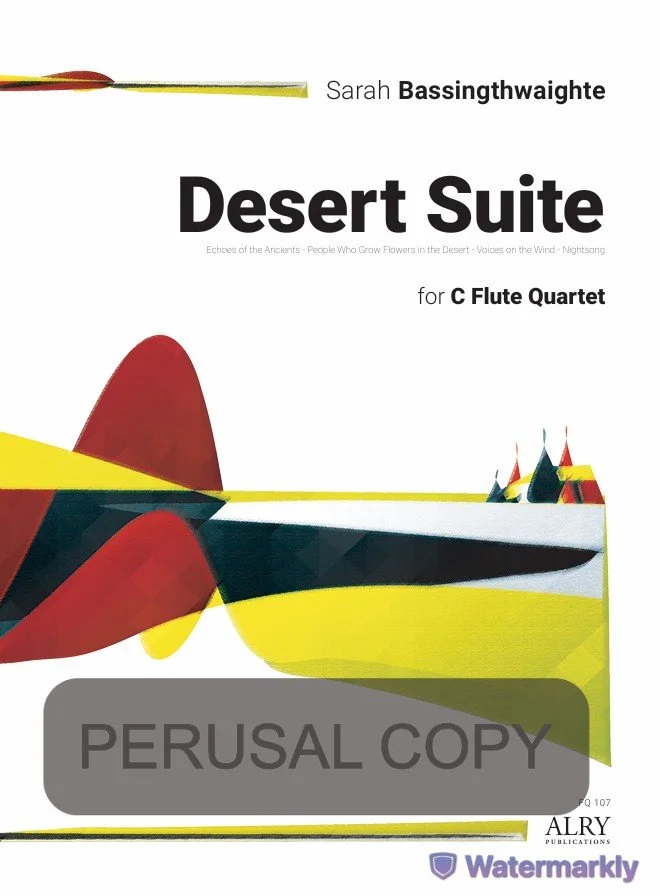
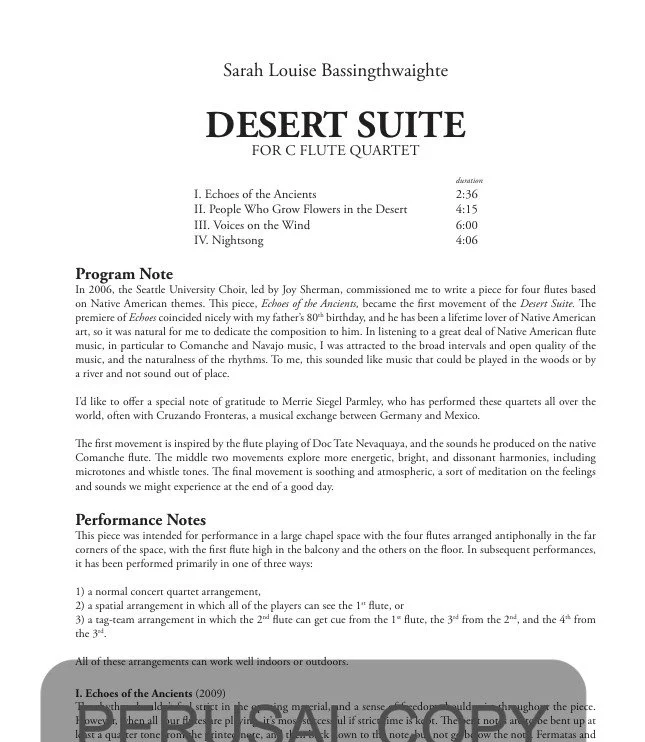
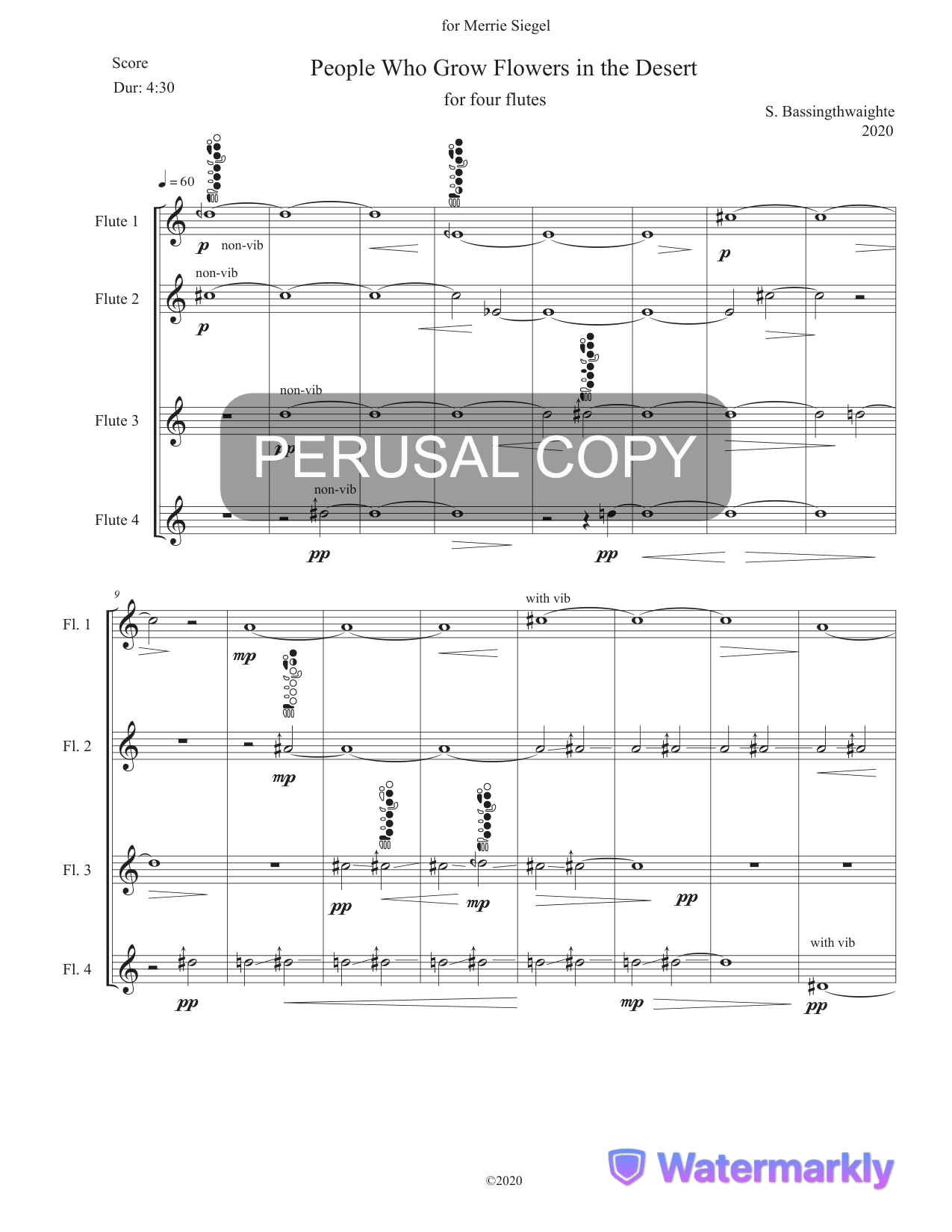
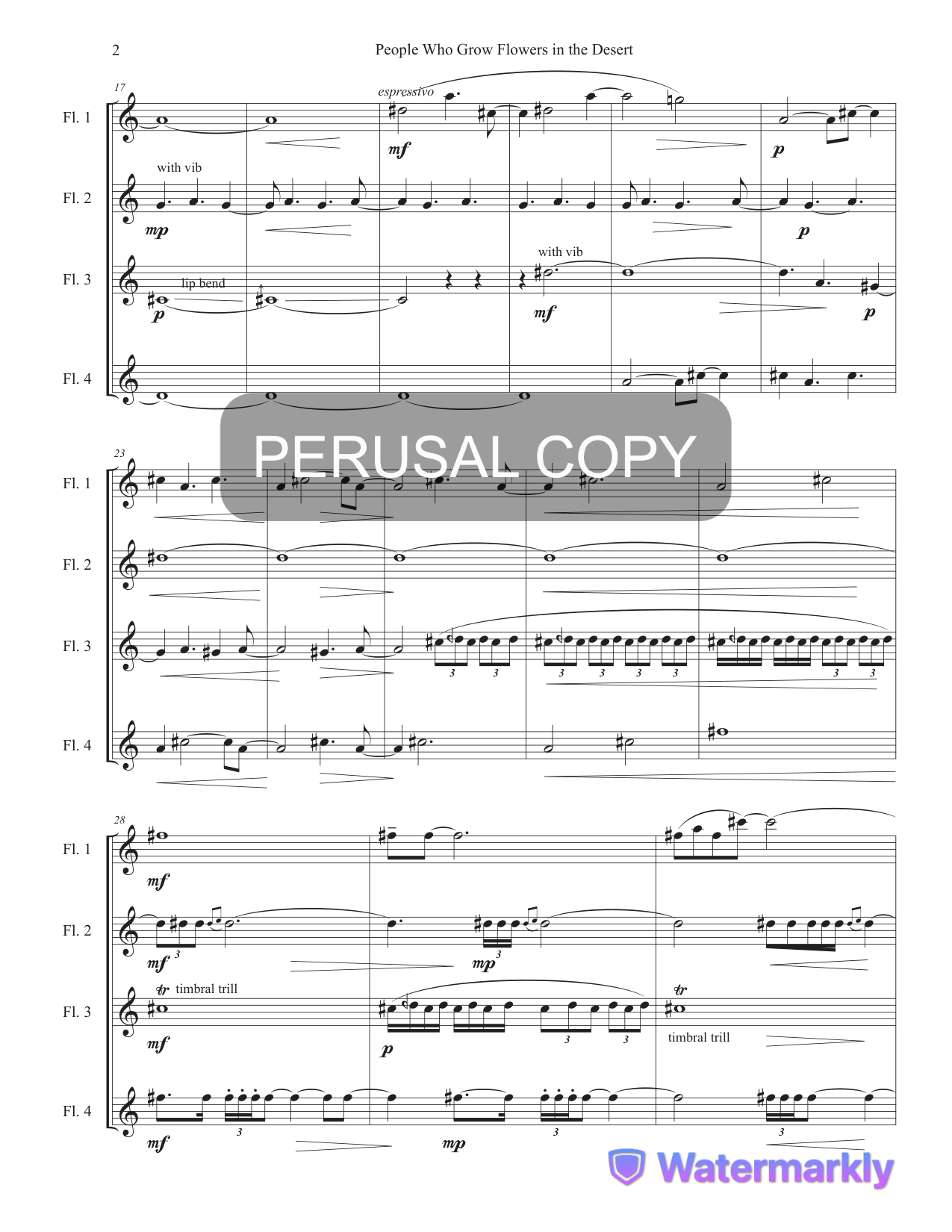
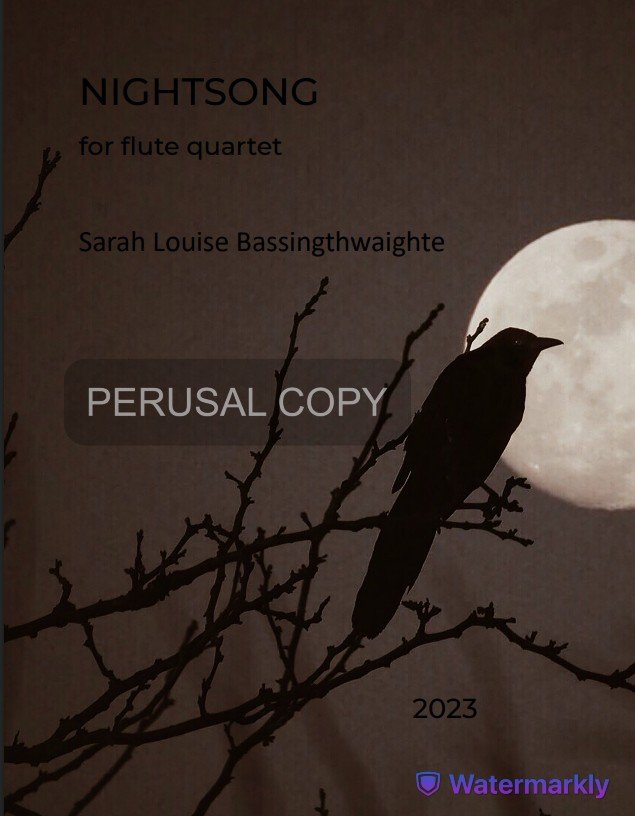
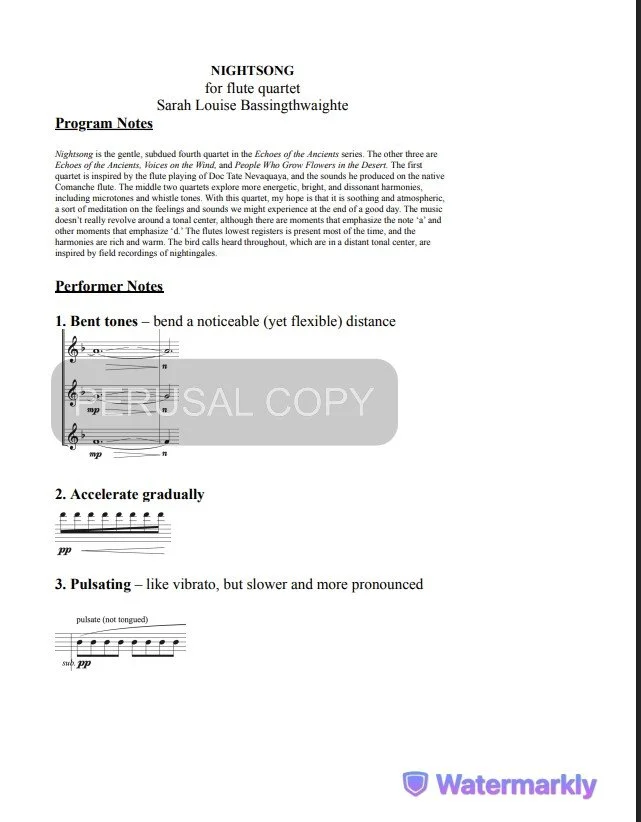
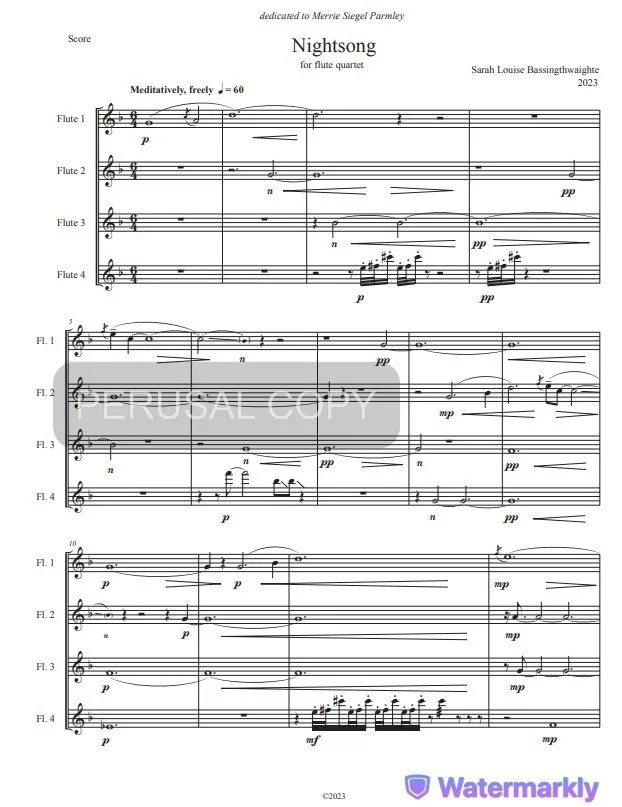
Nightsong is the gentle, subdued fourth quartet in the Echoes of the Ancients series. The other three are Echoes of the Ancients, Voices on the Wind, and People Who Grow Flowers in the Desert. The first quartet is inspired by the flute playing of Doc Tate Nevaquaya, and the sounds he produced on the native Comanche flute. The middle two quartets explore more energetic, bright, and dissonant harmonies, including microtones and whistle tones. With this quartet, my hope is that it is soothing and atmospheric, a sort of meditation on the feelings and sounds we might experience at the end of a good day. The music doesn’t really revolve around a tonal center, although there are moments that emphasize the note ‘a’ and other moments that emphasize ‘d.’ The flutes lowest registers is present most of the time, and the harmonies are rich and warm. The bird calls heard throughout, which are in a distant tonal center, are inspired by field recordings of nightingales.
Chamber Orchestra 1111 | 1110 | pno | 1 perc | strings
(2022)
11 minutes
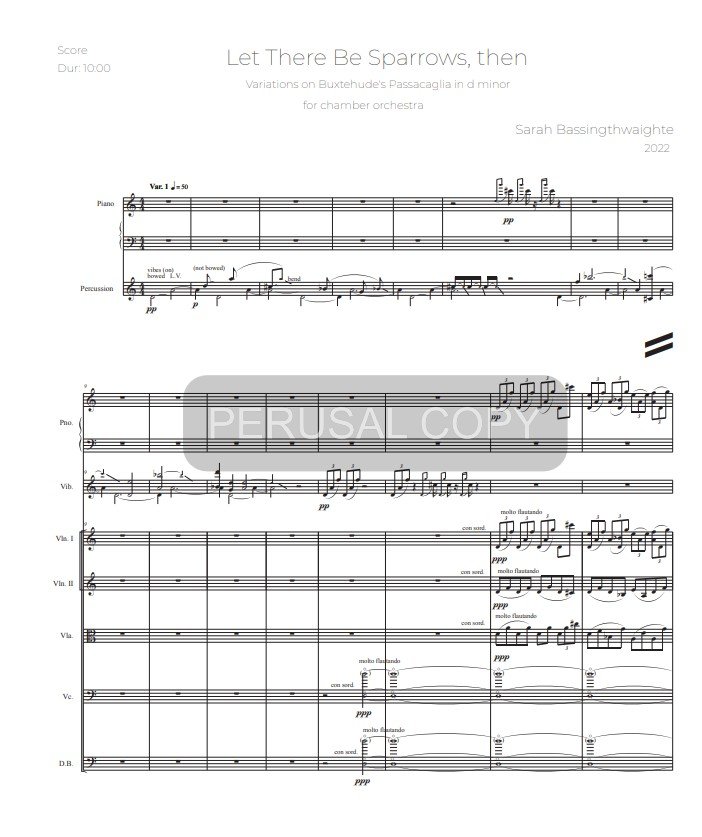
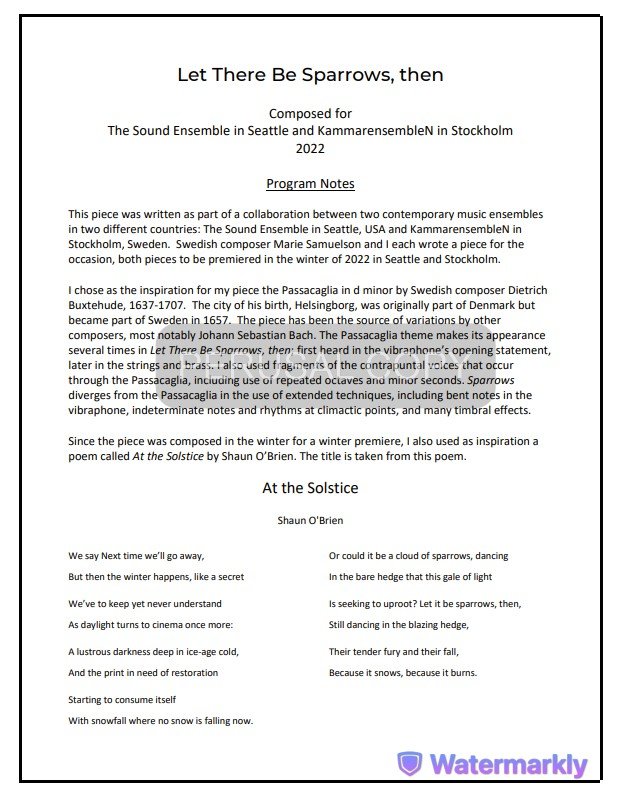
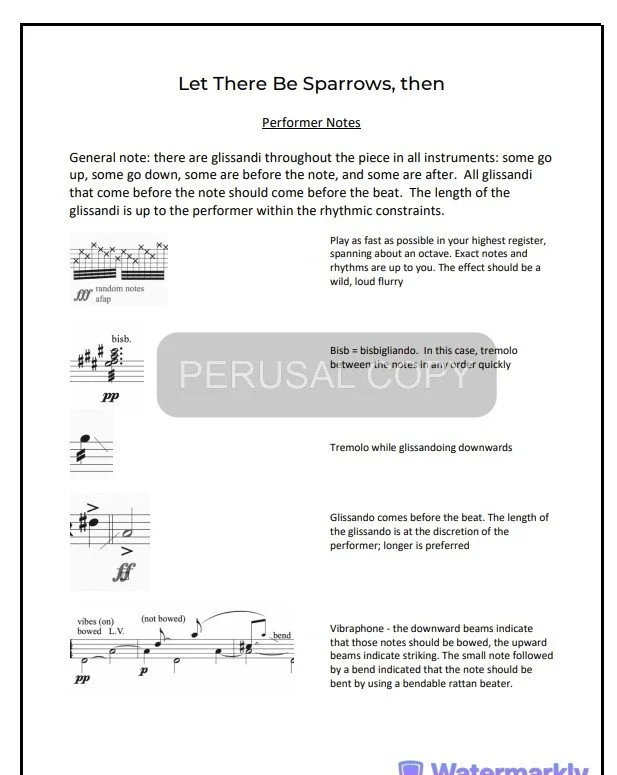
This piece was written as part of a collaboration between two contemporary music ensembles in two different countries: The Sound Ensemble in Seattle, USA and KammarensembleN in Stockholm, Sweden. Swedish composer Marie Samuelson and I each wrote a piece for the occasion, both pieces to be premiered in the winter of 2022 in Seattle and Stockholm. I chose as the inspiration for my piece the Passacaglia in d minor by Swedish composer Dietrich Buxtehude, 1637-1707. The city of his birth, Helsingborg, was originally part of Denmark but became part of Sweden in 1657. The piece has been the source of variations by other composers, most notably Johann Sebastian Bach. The Passacaglia theme makes its appearance several times in Let There Be Sparrows, then; first heard in the vibraphone’s opening statement, later in the strings and brass. I also used fragments of the contrapuntal voices that occur through the Passacaglia, including use of repeated octaves and minor seconds. Sparrows diverges from the Passacaglia in the use of extended techniques, including bent notes in the vibraphone, indeterminate notes and rhythms at climactic points, and many timbral effects. Since the piece was composed in the winter for a winter premiere, I also used as inspiration a poem called At the Solstice by Shaun O’Brien. The title is taken from this poem.
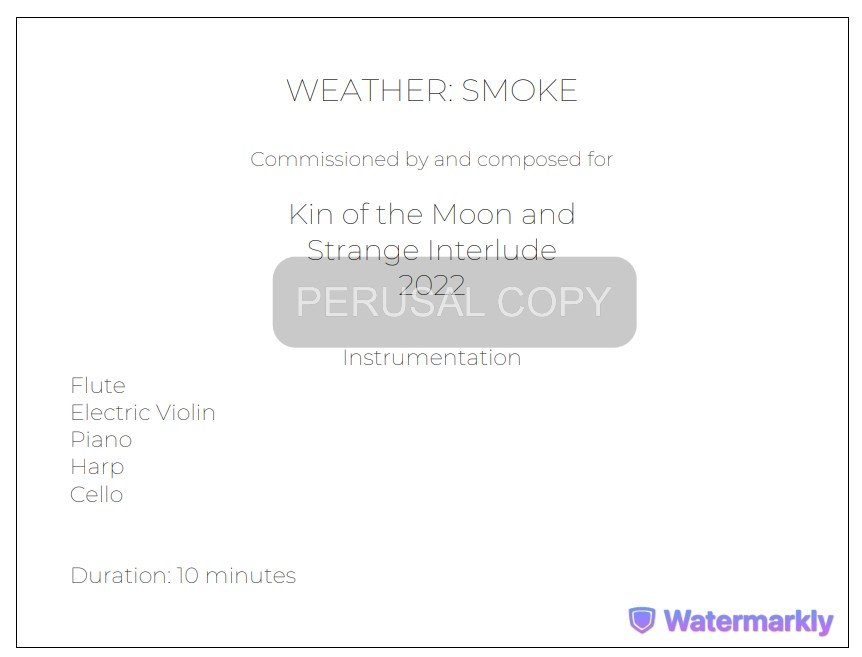

Flute, Electric Violin, Piano, Harp, Cello
(2022)
10 minutes
▶️Watch
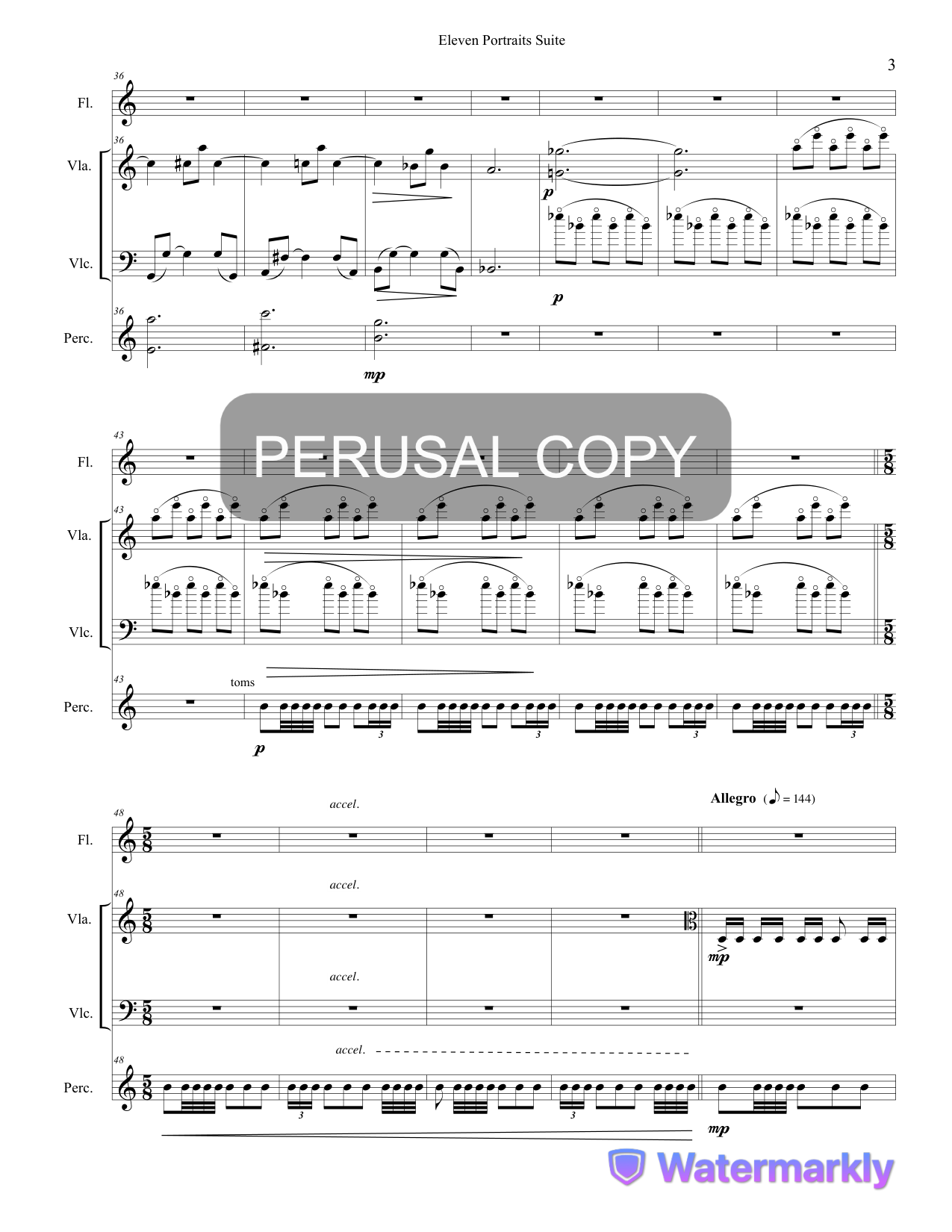
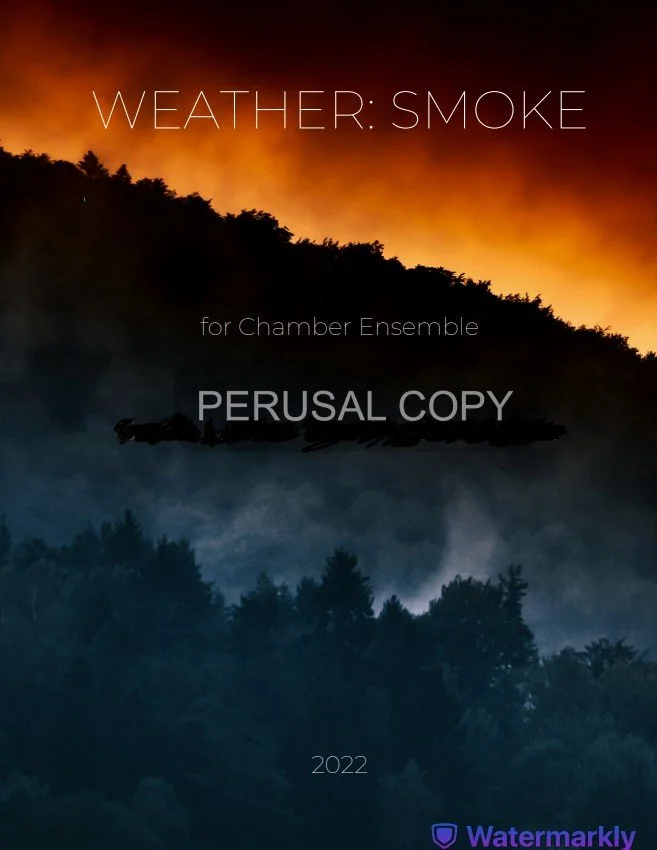
The idea for this piece came to me one day when I opened up the weather app on my phone, and the weather for the day was forecast as “smoke.” There was something about it being officially on the app that struck me - so quickly, the presence of forest fires and the smoke they create was expected, even normalized. In fact, people started calling smoke a season between summer and fall. I find this reality to be very distressing and sad, and I hope that we humans are able to make changes in time to save the beauty that is around us.
The piece is divided into 6 continuous movements: 1) Cool, 2) Warm, 3) Hot, 4) Fire, 5) Smoke, and 6) Rain.
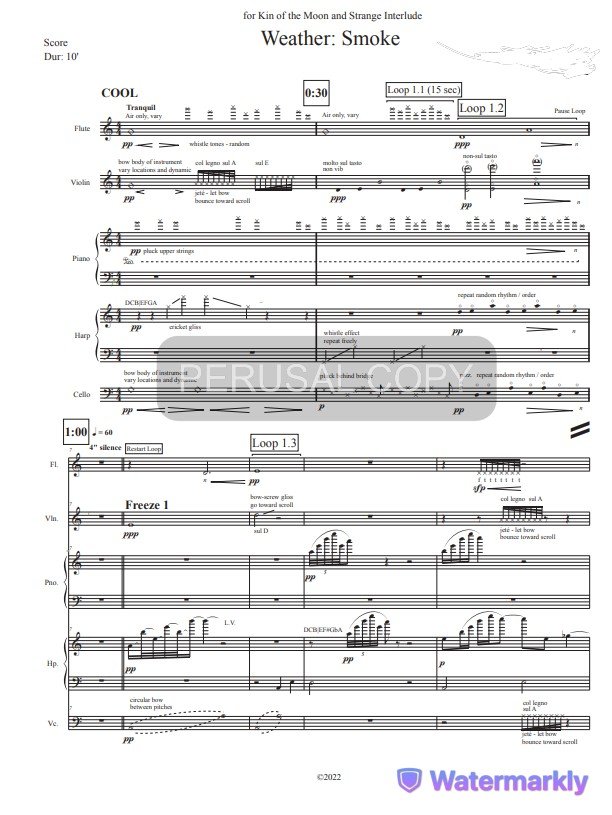
Inspired by the virtuosity and daring of these outstanding performers, I utilized my full palette of extended techniques with the hopes of conjuring these ideas in a visceral and evocative way. The score takes a minute to soak up, it is visually somewhat unusual. I created my own notation for some of the techniques (such as crumpling paper or throwing ping pong balls), and communicated with the performers about ways that I could make it easy for them to read and execute.
The piece is intended to be performed as a multi-media event. The lengths of the movements are determined by time elapsed - there are markers in the music for each minute. These markers correspond to events in a video that has been created for the piece by San Francisco digital artist and videographer Joe Moore. The images match the dynamic, restless quality of the sounds, and both reach for the extremes of beauty and alarm.
Flute Choir (flexible)
(2020)
3 minutes
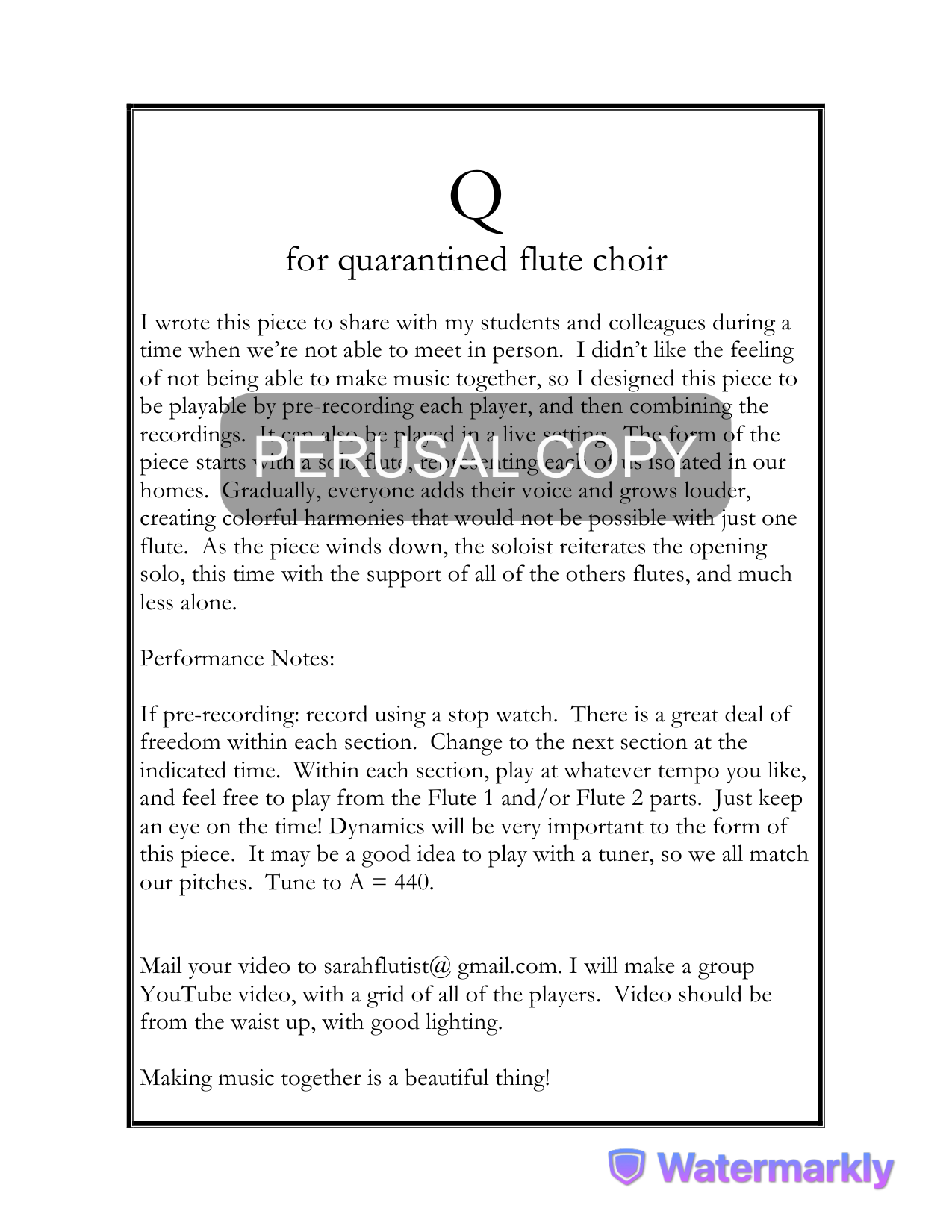
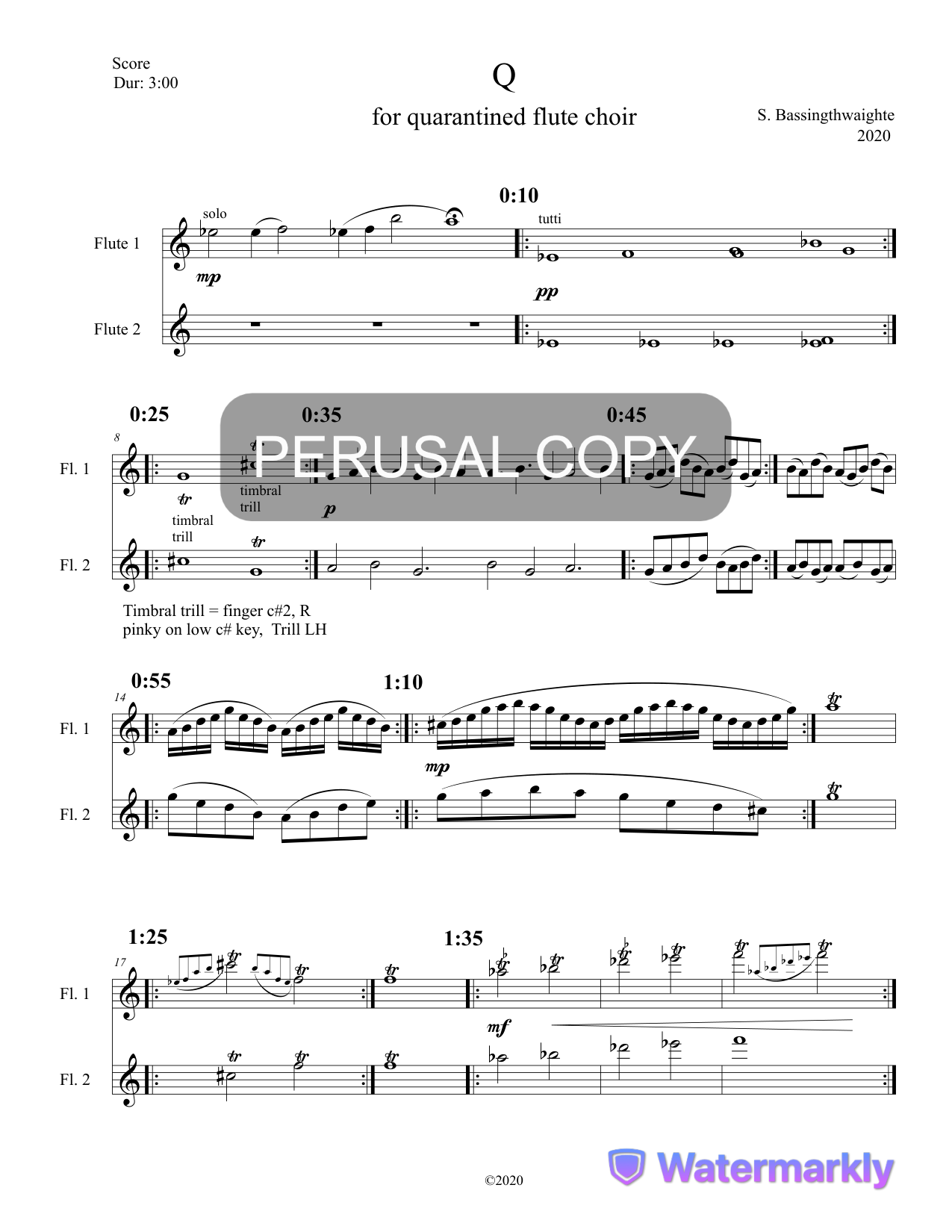
Q for Quarantined Flute Choir is a response to shelter-in-place limitations amidst the 2020 pandemic and the difficulties of playing and recording as an ensemble. Each player records their part, eventually to be combined into a whole; coordination is achieved through using time markers instead of measures or ensemble direction. However, Q can also be performed in a live concert setting, again using stopwatches (timers), or with a leader cueing when to move on to the next musical cell.
Variable Ensemble
(2018)
3-5 minutes
Overview:
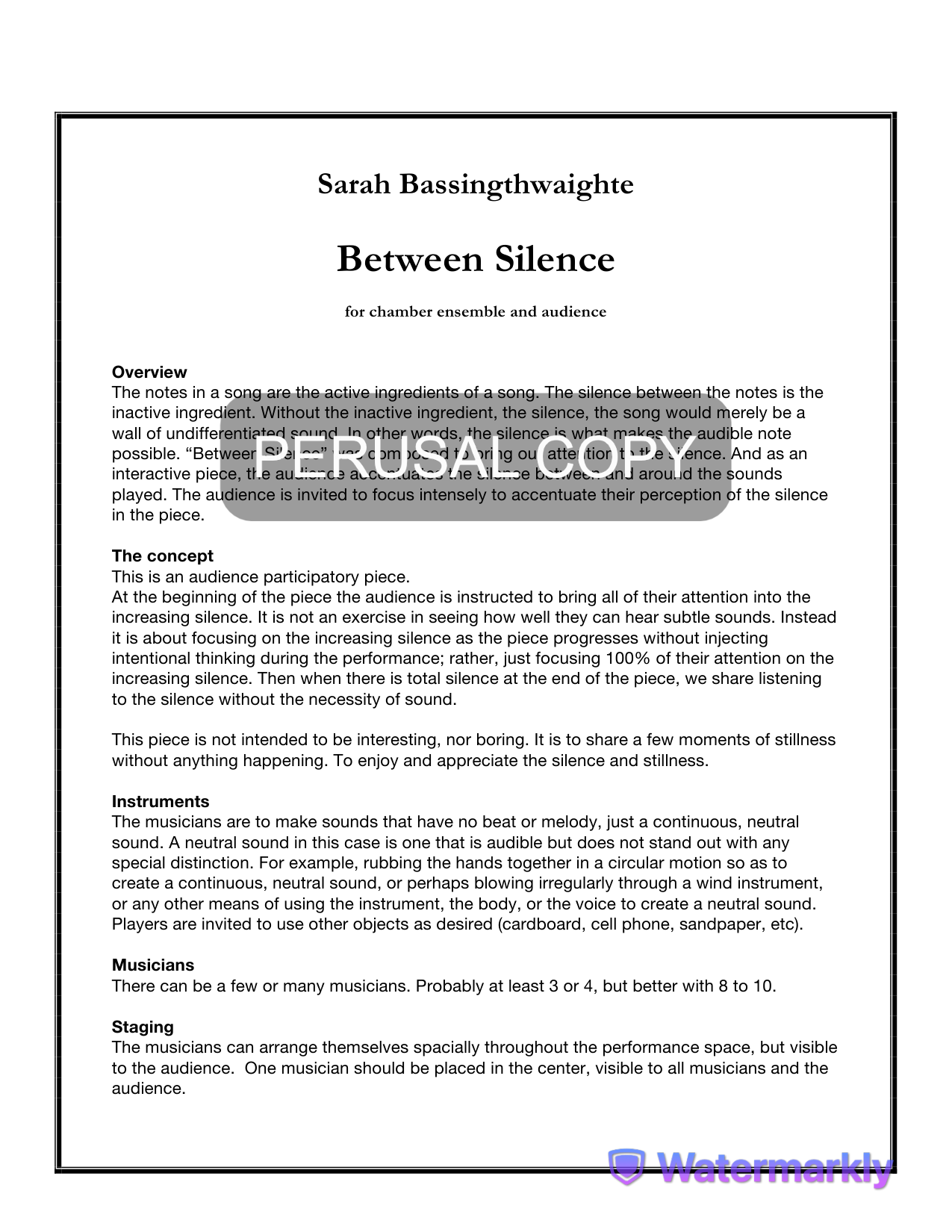
The notes in a song are the active ingredients of a song. The silence between the notes is the inactive ingredient. Without the inactive ingredient, the silence, the song would merely be a wall of undifferentiated sound. In other words, the silence is what makes the audible note possible. “Between Silence” was composed to bring our attention to the silence. And as an interactive piece, the audience accentuates the silence between and around the sounds played. The audience is invited to focus intensely to accentuate their perception of the silence in the piece.
Flute choir (flexible)
(2013)
5 minutes
Composed for students of the composer in 2013, Water Tower Music I was intended to be played and was ultimately premiered in the water tower of Volunteer Park in Seattle. With all the players reading from the same score, the piece can be played with any number and type of flutes and is designed to be played out-of-sync. Five additional copies of the score are included with the printed version, and performers can make as many more additional copies as needed.
4 C-Flutes
(2012)
6 minutes
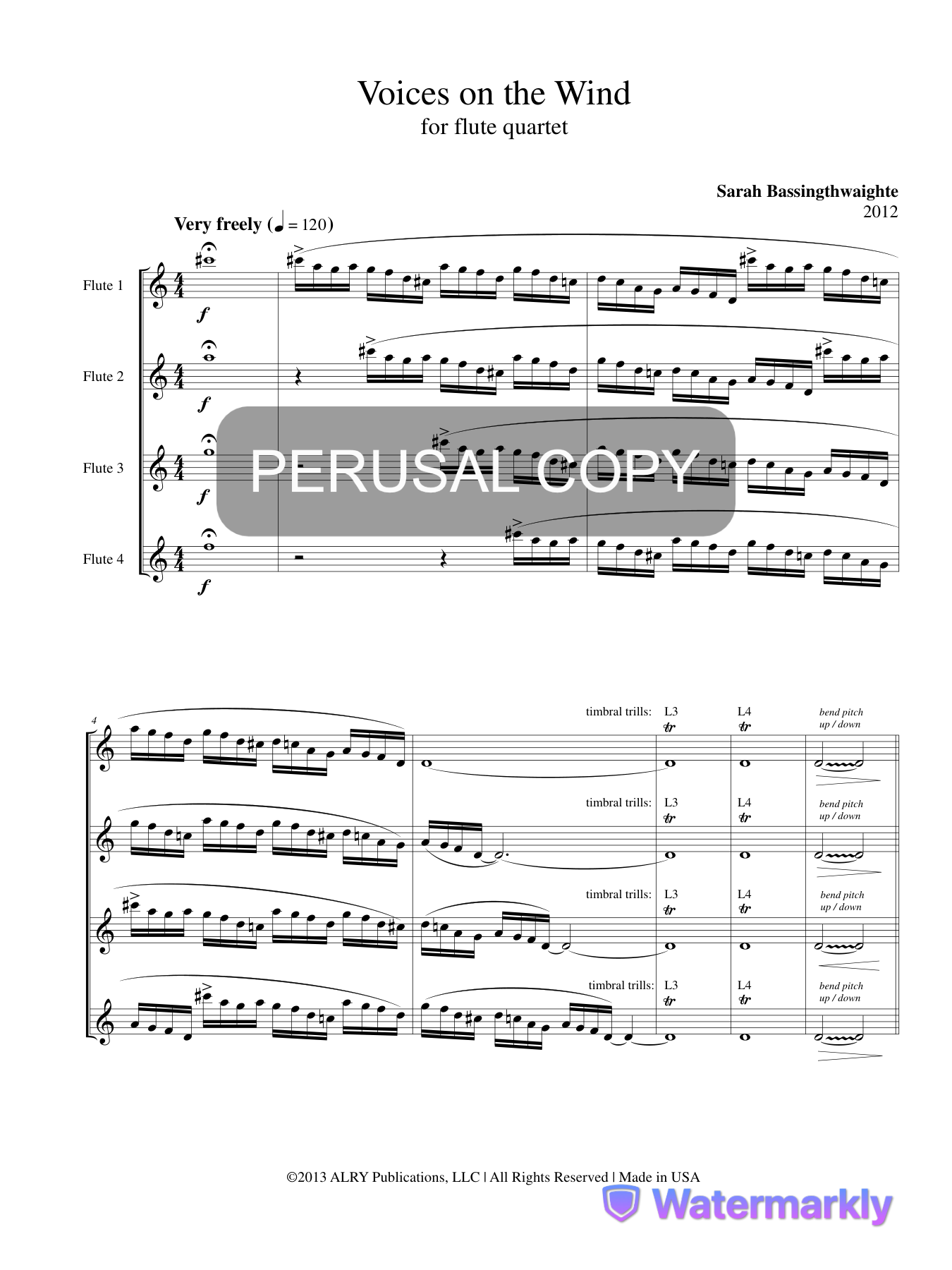
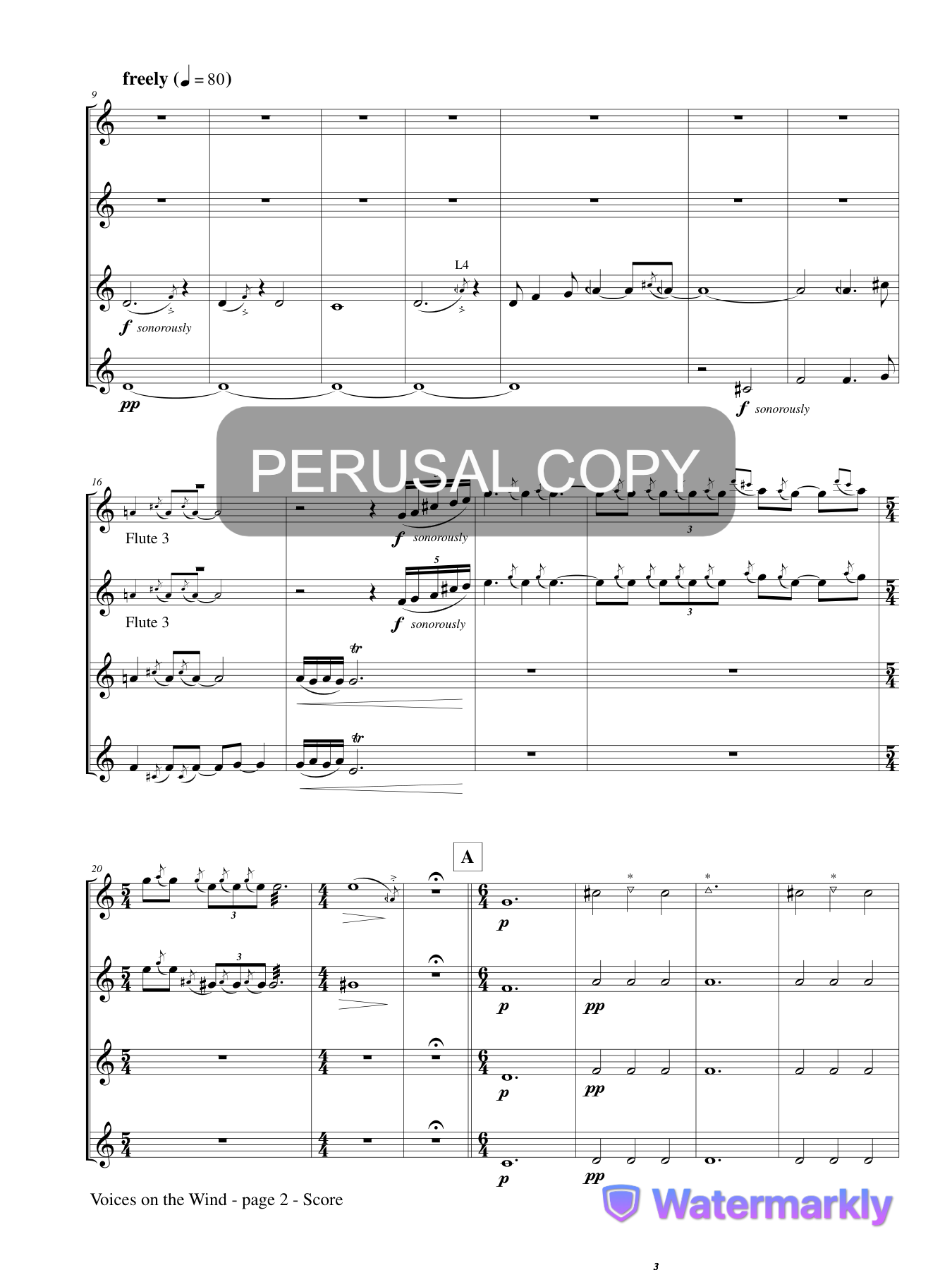
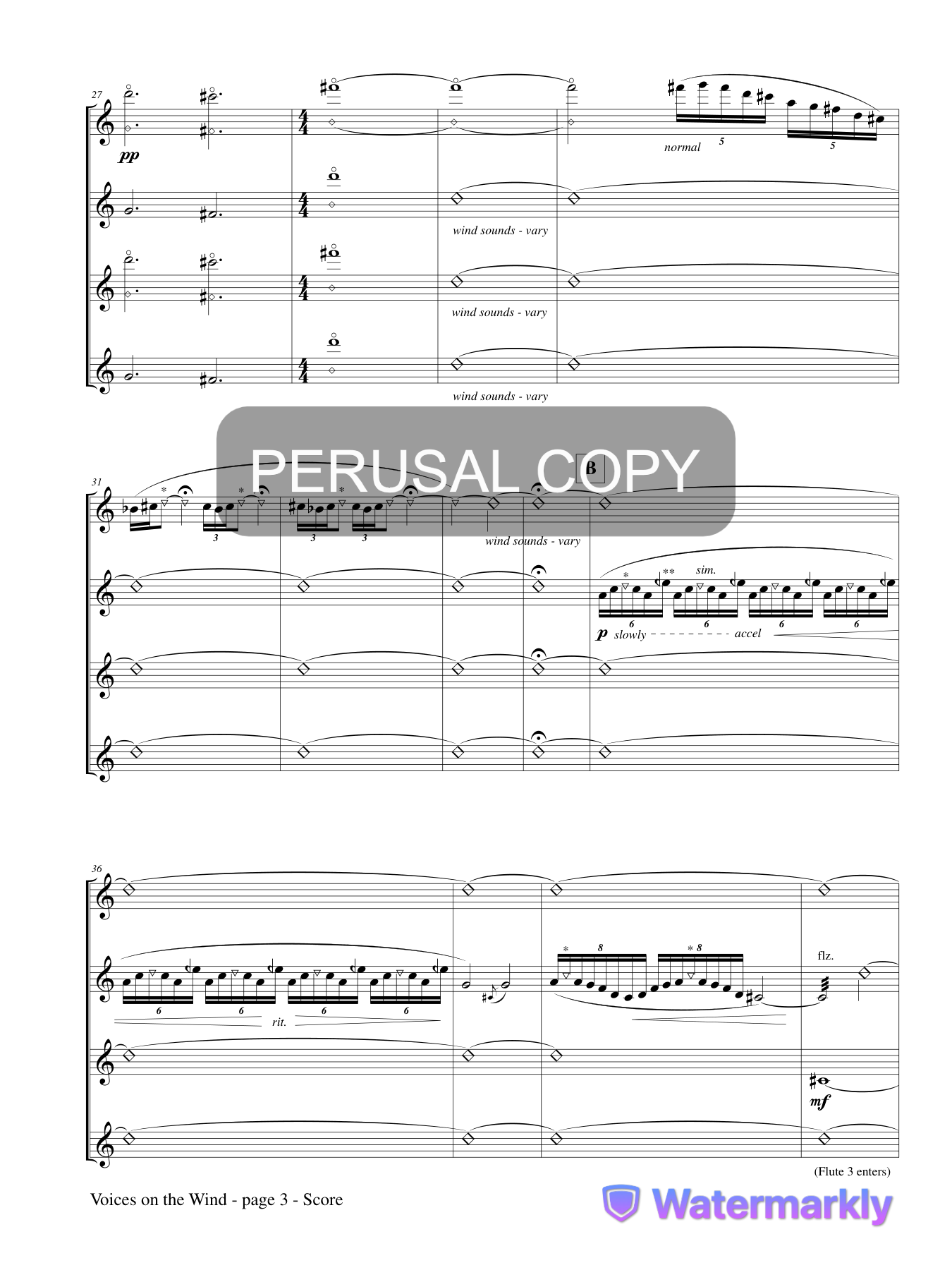
Voices on the Wind (Flute Quartet) by Sarah Bassingthwaighte, Published by Alry Publications.
Intended as a follow-up to "Echoes of the Ancients", this work is slightly more adventurous and is a great introduction to extended techniques. With full explanations in the notes, players will experience timbral trills, microtones, as well as some pitch bending and harmonics.
Scored for four C Flutes.
4 C-Flutes or 4 Violins
(2006)
3 minutes
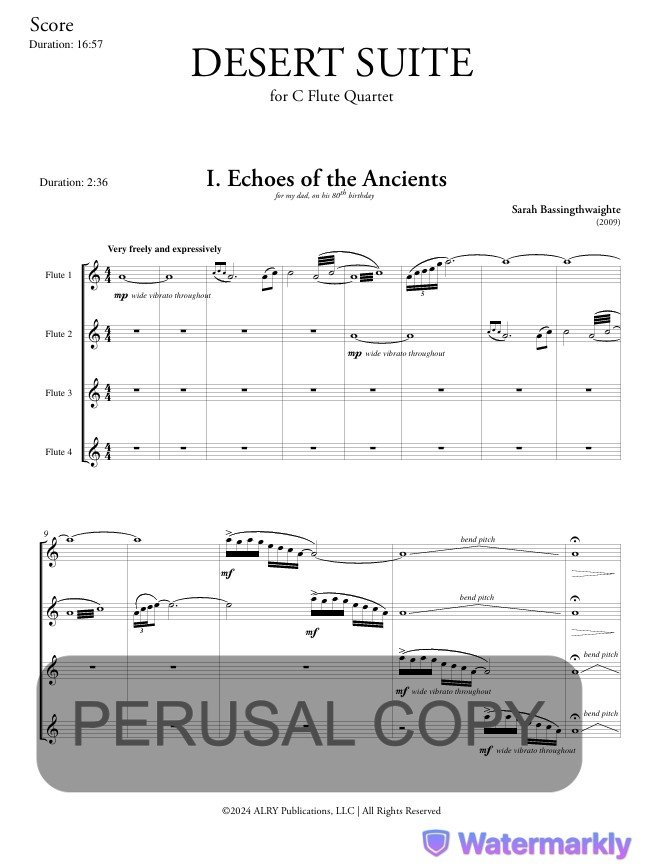
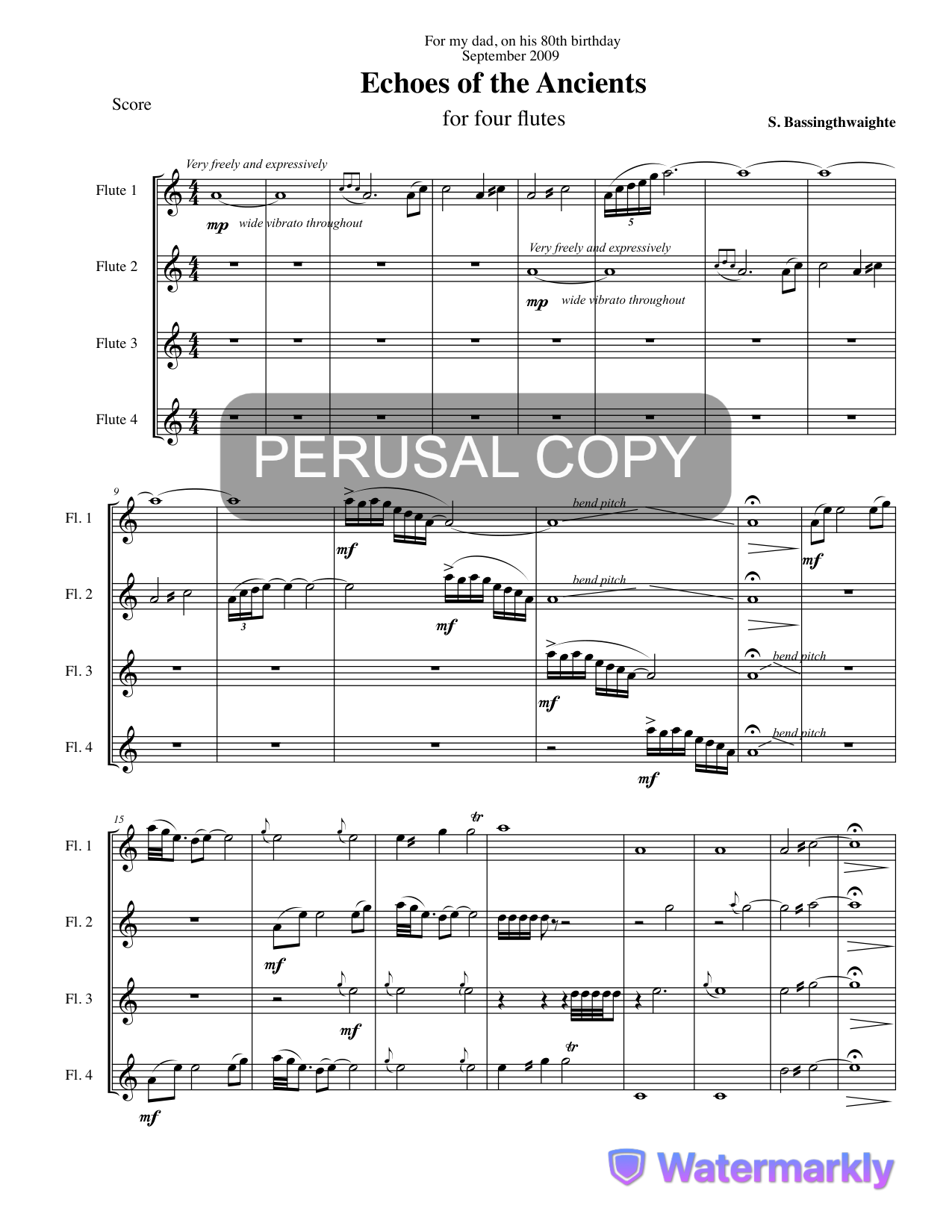
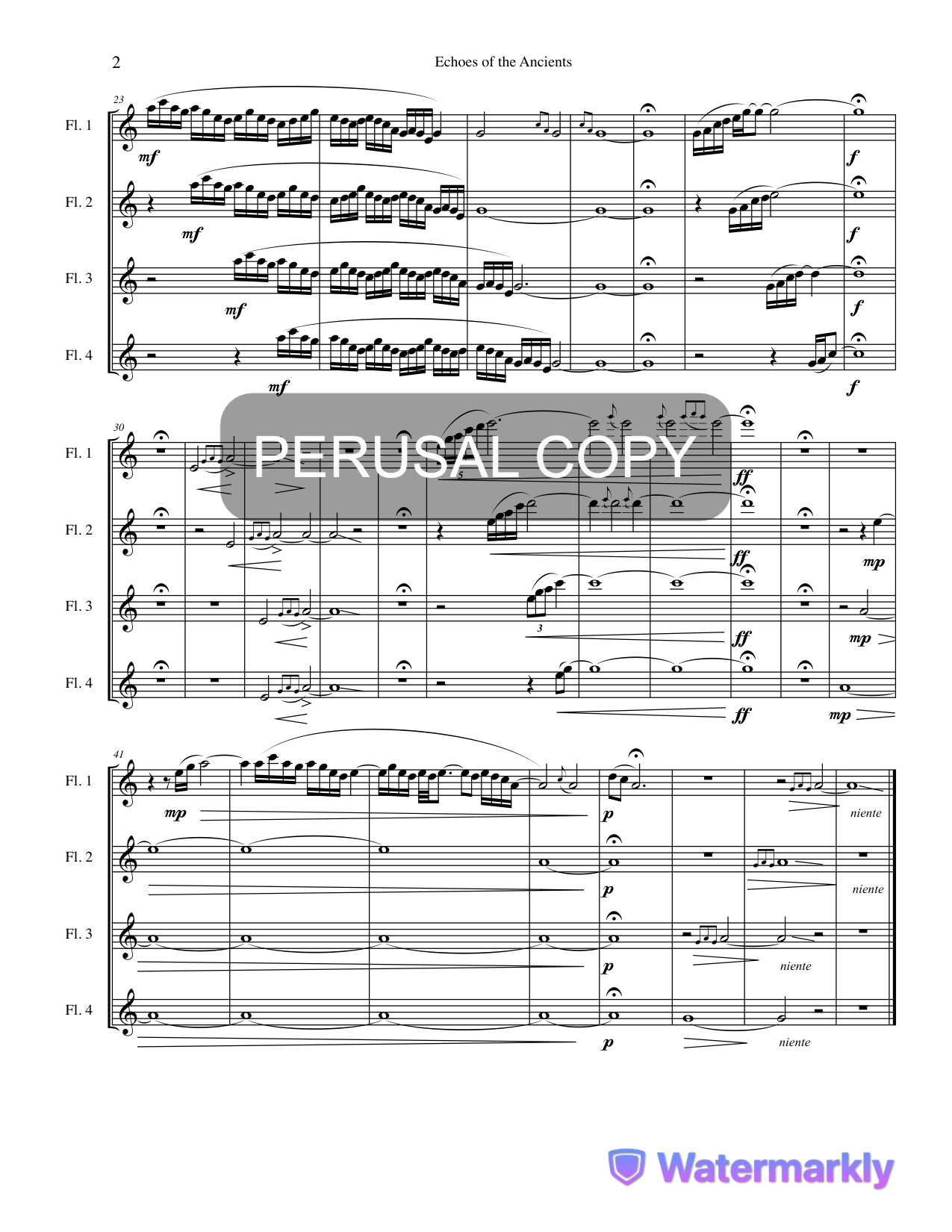
Commissioned in 2006, Echoes of the Ancients was first composed for four C flutes, based on Native American themes. For students, it is a good introduction to pitch bending and tremolos. Very free in nature, this work can be played in a variety of venues ranging from an echoing cathedral, to the middle of the forest. In 2023, it was adapted by the composer to be played by four violins at the American String Teachers Association National Conference.
No results match your search. Try removing a few filters.